
Data Ownership and Privacy: Practical Boundaries in a Connected World
Most people think privacy is about hiding. It isn’t. Privacy is about control: who can access your information, what they can do with it, and what happens when you say “no.”
Data ownership is the adjacent idea: if your behavior, identity, and work generate value, what rights do you retain over that value? In practice, ownership is messy — it’s split across law, contracts, technology, and power. But you can still reason about it clearly, and build systems that behave predictably.
Three Types of “Your Data”
“Your data” isn’t one thing. It’s helpful to separate it into three buckets:
- Provided data: what you intentionally submit (email, profile info, uploaded files).
- Observed data: what platforms infer from you (clicks, location, device fingerprints, usage patterns).
- Derived data: what is computed about you (risk scores, recommendations, embeddings, classifications).
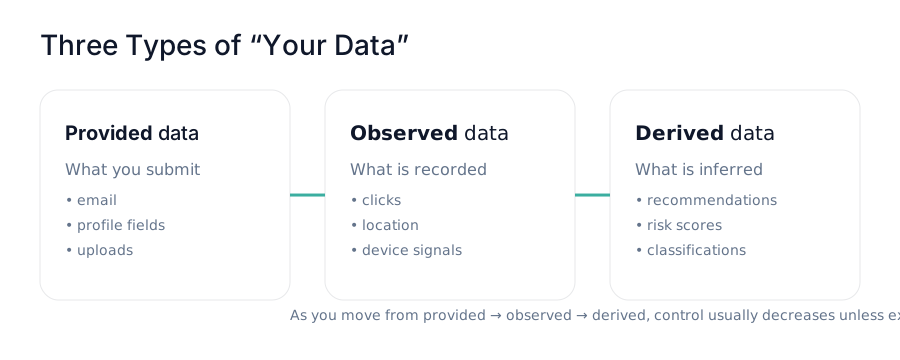
The biggest privacy surprises happen in the last two categories. People expect platforms to store what they type. They don’t expect platforms to predict what they will do next.
Ownership vs. Rights
“Ownership” sounds absolute, but most real systems run on a bundle of rights:
- Access: can you view and download what’s stored?
- Portability: can you move it somewhere else in a usable format?
- Deletion: can you remove it, and from which systems?
- Consent: can you meaningfully opt in or out of specific uses?
- Auditability: can you see who accessed it and why?
When you evaluate a product (or design one), don’t ask “Who owns the data?” Ask: “Which of these rights do users actually have, and how hard is it to exercise them?”
The Typical Data Lifecycle
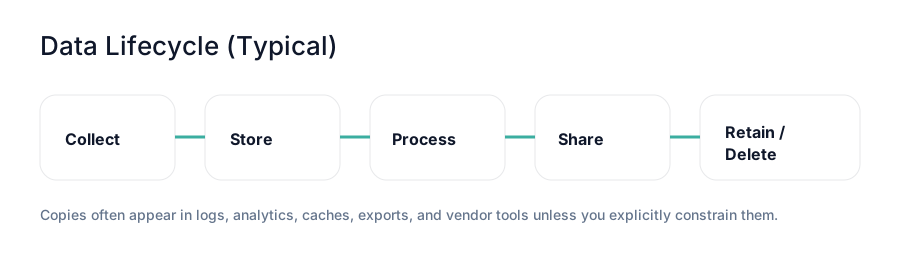
Privacy issues are usually lifecycle issues. Data tends to live longer and travel further than teams expect. A simple feature can quietly create copies in logs, analytics, caches, backups, and third-party systems.
Practical Privacy: What Good Looks Like
The best privacy posture is not a banner or a policy page. It’s product behavior. Here are patterns that work in practice:
1. Collect less by default
Start with a minimal data model and earn additional fields. Treat every new field as a permanent liability. If you don’t have the field, you can’t leak it.
2. Separate identity from activity
If you can decouple user identity from usage events (even partially), you reduce blast radius. Use short-lived identifiers and avoid linking everything back to a single global user key.
3. Make consent granular
“Accept all” is not consent, it’s fatigue. Let users opt into specific uses: analytics, personalization, marketing, third-party sharing, model training, etc.
4. Treat deletion as a first-class feature
Deletion is hard because systems copy data. That’s exactly why it must be designed early. Good deletion means: primary store + derived indexes + analytics + backups policy.
A Simple Rule for Builders
If you build products, here’s a rule that tends to prevent bad outcomes:
Only collect data you could confidently explain on stage, with the user in the front row.
It’s not a legal standard. It’s an empathy standard. Most privacy scandals happen when behavior is “allowed” but unjustifiable.
Conclusion
Data ownership is complicated in theory but actionable in practice. Think in rights, not slogans. Design lifecycles, not just storage. And remember: privacy is less about secrecy and more about keeping promises.