
AI/ML in Real Life (Not Hype)
AI headlines often promise “revolution,” but most useful machine learning is quieter. It shows up as fewer manual steps, fewer mistakes, faster decisions, and better defaults. The trick is to look for places where prediction or pattern-matching is already happening in human heads — and then ask whether a model can do it reliably enough to be worth the operational cost.
This article focuses on the practical: what ML is good at, what it’s bad at, and how successful teams ship it without turning everything into a science project.
Where ML Works Best
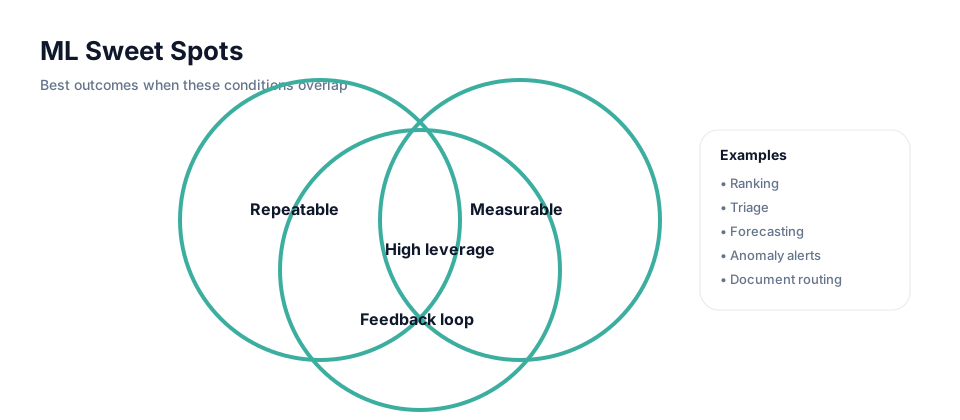
ML tends to work when:
- The decision repeats (thousands of times per day/week)
- The outcome is measurable (click, purchase, churn, defect, delay)
- You can tolerate some error (rankings, recommendations, triage)
- Inputs are available (logs, transactions, images, text)
- There’s a feedback loop (you learn whether the decision helped)
Everyday Use Cases That Actually Ship
Real-world ML is often “small” in scope but high in leverage:
1. Ranking and Recommendations
Choosing “which items first” is a natural ML problem: search results, product listings, support articles, content feeds, alerts. You don’t need perfect prediction — you need a better ordering than a naive baseline.
2. Triage and Prioritization
Many teams drown in queues: customer tickets, fraud reviews, quality checks, compliance approvals. ML can score items by risk or urgency so humans spend time where it matters.
3. Forecasting and Capacity Planning
Inventory, staffing, delivery times, cloud usage — forecasting reduces “panic operations.” Even simple models can outperform gut feel when the same planning mistake repeats monthly.
4. Anomaly Detection
Detecting “something looks off” works well when normal behavior is stable enough. This is common in observability (traffic spikes), finance (unusual activity), and manufacturing (sensor readings).
5. Text and Document Automation (With Humans in the Loop)
Classification, extraction, summarization, routing — especially when the workflow is: machine suggests, human confirms, system learns.
The Typical “ML Request” That Fails
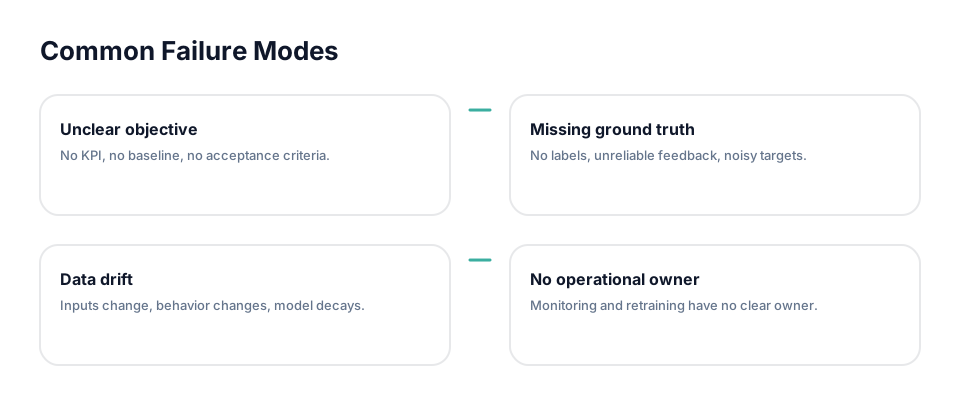
ML projects fail for predictable reasons:
- Unclear objective: “use AI” is not a goal. A measurable KPI is.
- No labels / no ground truth: you can’t learn what you can’t verify.
- Data drift: yesterday’s model faces today’s reality.
- No operational owner: if nobody owns monitoring, it decays.
- Automation without workflow design: the model output doesn’t fit how work gets done.
A Practical Deployment Pattern
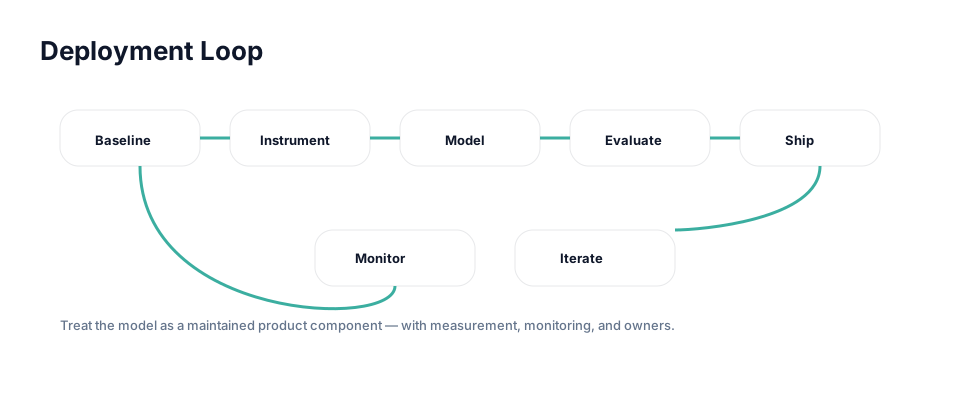
A grounded approach looks like this:
- Start with a non-ML baseline (rules, heuristics, sorting, thresholds).
- Instrument outcomes so you can measure improvement.
- Introduce ML as a “suggestion layer” before full automation.
- Evaluate against real-world costs (false positives, review time, user trust).
- Monitor drift and retrain intentionally, not magically.
What “Not Hype” Sounds Like
If you want to stay realistic, use boring language: “We reduced manual review time by 18%,” “We improved on-time delivery forecasts,” “We lowered false declines,” “We cut alert noise.” Real ML work lives in metrics, not demos.
Conclusion
ML is most valuable when it’s embedded into a workflow, tied to measurable outcomes, and maintained like production software. The win is rarely “intelligence.” It’s usually consistency at scale.