
Focus, Deep Work, and Creativity: Building a System That Protects Attention
Creativity looks like inspiration, but it behaves like engineering: it improves when inputs are reliable and interruptions are controlled. Deep work is the practice of making that reliability intentional.
The goal isn’t to become a monk. The goal is to create predictable conditions for meaningful work, even in a noisy environment.
Why Focus Is Hard Now
Modern work rewards responsiveness: notifications, messages, “quick calls,” and real-time dashboards. But creativity and depth reward the opposite: long stretches of uninterrupted time where your brain can build and refine models.
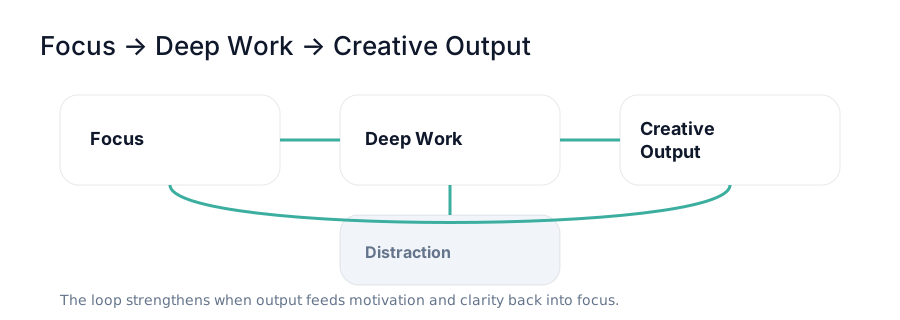
The Three-Layer Model of Attention
If you want consistent deep work, think in layers:
- Environment: what you see/hear (devices, tabs, people, spaces).
- Rules: what you allow (when to check messages, what counts as “done”).
- Rituals: how you start (a repeated sequence that signals “depth begins now”).
Most people try to solve focus with willpower. Willpower is the last layer. Environment and rules do most of the work.
A Minimal Deep Work Protocol
Step 1: Define a single target
Not “work on the project.” A single concrete target: “Draft the outline,” “Fix the onboarding bug,” “Write the first 500 words,” “Ship version 0.2.” Ambiguity invites distraction.
Step 2: Timebox and remove exits
Choose a timebox you can realistically honor (often 45–90 minutes). Then remove the exits: close chat, silence the phone, and don’t keep “just one tab” open for later.
Step 3: Use a start ritual
A ritual is a repeatable sequence that lowers the activation energy: open the doc, review the last paragraph, write one ugly sentence, continue. The ritual is not about motivation — it’s about momentum.
Step 4: End with a breadcrumb
Stop mid-step and leave a note: “Next: write the example,” “Next: refactor this function,” “Next: update the diagram.” Breadcrumbs make returning easy.
Creativity Is a Throughput Problem
Many people treat creativity like a rare resource. But creative output often increases when you produce more drafts. Quantity creates material; material creates quality.
The trick is to separate creation from evaluation:
- Create: fast, messy, non-judgmental.
- Evaluate: slow, selective, precise.
If you evaluate while you create, you create less. If you create freely and evaluate later, you create more — and the evaluation has better options.
Common Mistakes
- Scheduling depth “when I have time” (you won’t).
- Trying to do deep work with open chat (it’s a trap door).
- Using the internet as a comfort blanket (research becomes avoidance).
- Confusing motion with progress (busy is not deep).
Conclusion
Deep work isn’t a personality trait. It’s a system. Protect attention with environment, rules, and rituals. Then let the brain do what it does best: connect ideas, refine them, and produce something real.