
Monetizing Digital Products: Pricing Models That Actually Work
Monetization isn’t about “charging money.” It’s about aligning value: the customer gets a predictable outcome, and you get a predictable business.
Digital products are attractive because marginal cost is low — but distribution, trust, and support are not free. Pricing is how you fund the parts that make the product reliable.
The Four Common Models
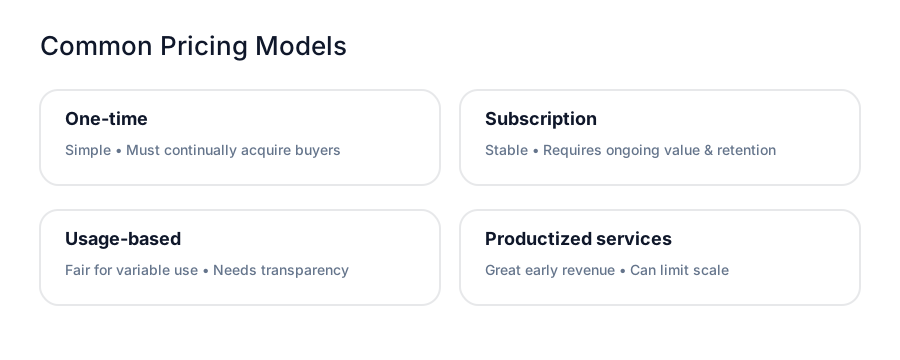
1) One-time purchase
Best for: templates, ebooks, small utilities, lifetime tools with low ongoing costs. The advantage is simplicity. The risk is that you must constantly find new buyers.
2) Subscription
Best for: tools that deliver ongoing value (monitoring, collaboration, content libraries). Subscriptions work when the product becomes part of a routine.
3) Usage-based
Best for: APIs, compute, high-variance workloads. Customers like paying for what they use, but you must prevent surprise bills and make usage transparent.
4) Productized services (attached to a product)
Best for: early-stage products, niche audiences, high-touch results. Services can bootstrap revenue and teach you what features to build next.
How to Pick a Model
A good model matches three realities:
- Value frequency: how often does the customer feel the benefit?
- Cost frequency: how often do you incur costs (support, infrastructure, updates)?
- Trust threshold: how much must the customer trust you before paying?
If value is continuous (daily/weekly), subscriptions fit. If value is occasional but intense, usage-based can fit. If value is a one-off transformation (a course, a template), one-time can fit.
Pricing Tiers Without Overthinking
Many digital products do well with three tiers:
- Starter: for curious users, low price, limited scope.
- Pro: the default for most paying users, best value.
- Team / Business: collaboration, admin features, higher limits, priority support.
Don’t create tiers by randomly cutting features. Create tiers by scaling limits (projects, usage, seats) and risk reduction (support, onboarding, reliability).
Bundling: The Fastest Way to Increase Revenue Per Customer
Bundles work because they reduce decision fatigue and increase perceived completeness. A bundle might combine:
- a core tool
- templates / presets
- documentation / playbooks
- community access or office hours
The secret: bundle around a workflow, not around files. People pay for “a system that helps me do X,” not “more stuff.”
Reducing Refunds and Chargebacks
- Be explicit: show what the product does and does not do.
- Offer a fast win: give users value in the first 5–10 minutes.
- Use clear onboarding: a checklist beats a long tutorial.
- Keep billing transparent: especially for usage-based products.
Conclusion
Monetization works when it’s a promise: “Pay this amount, get this outcome, with this level of support and reliability.”
Pick a model that matches value frequency, cost frequency, and trust. Keep tiers simple. Bundle around workflows. And optimize for long-term clarity, not short-term cleverness.